

The Ford Model T and the Making of Modern Driving
October 1, 1908. Detroit wakes to the clatter of streetcars and the smell of coal smoke, and somewhere inside Ford’s Piquette Avenue plant a simple promise is being wheeled into daylight. It isn’t the first car, or the fanciest, or even the fastest. But it is, at last, the one meant for ordinary people who have fences to mend, shifts to make, and groceries to haul. Ford calls it the Model T, and the number that matters as much as the name is the sticker: about $850 to start—starkly lower than the hand-built playthings that crowded early showrooms.
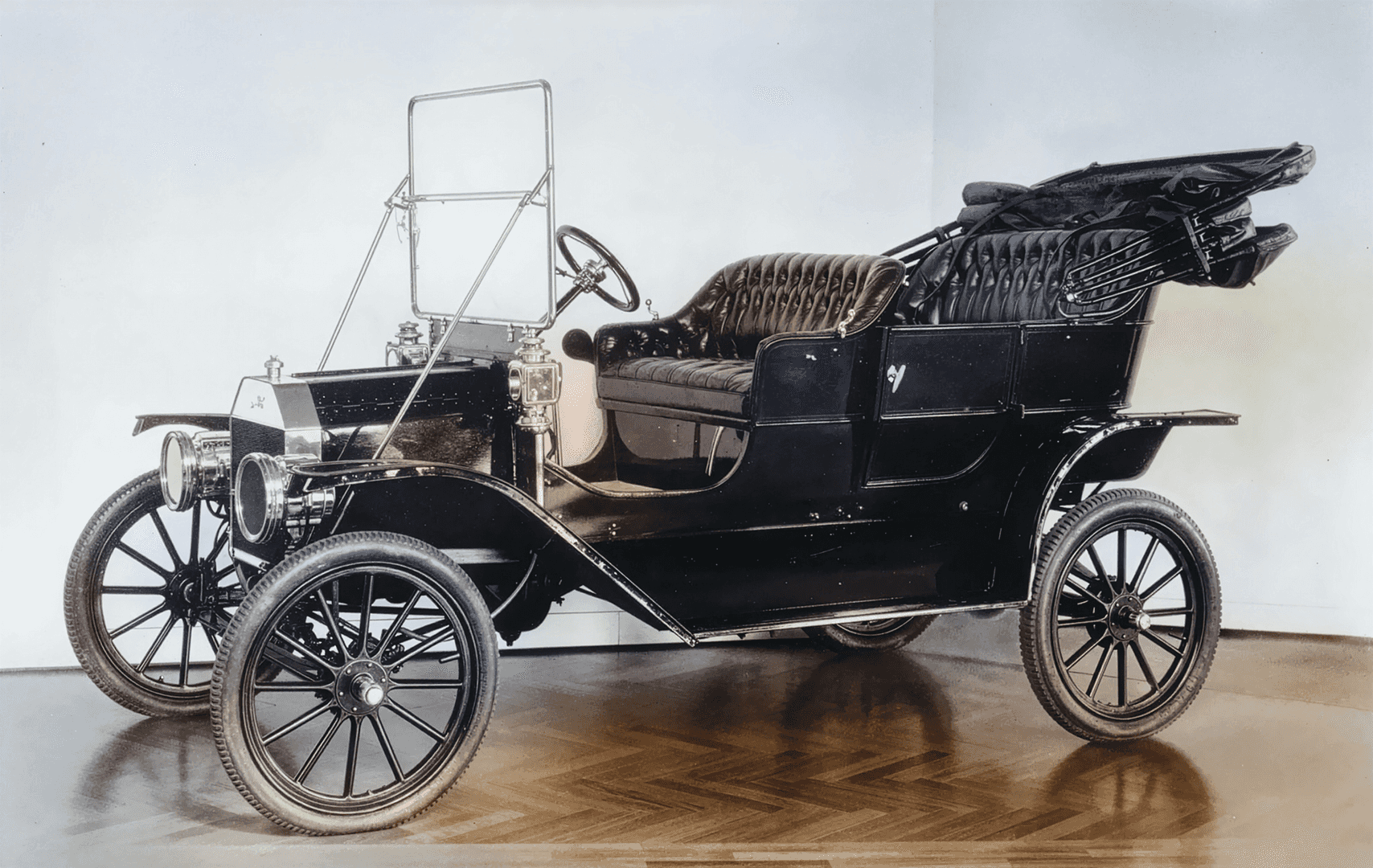
The pitch is audacious in its plainness. No jeweled coachwork, no aristocratic pretense. Strong vanadium steel so it won’t fold under rutted roads. A simple, high-riding chassis so it can ford creeks and shrug off mud. Left-hand steering to meet the evolving rules of the road. It is designed to be driven, fixed, and driven again—by farmers with oil-stained hands, by shopkeepers in Sunday collars, by anyone who can learn the new language of throttle and spark.
Henry Ford has been saying he wants “a car for the great multitude,” and on this date that idea stops being slogan and starts becoming object. Buyers won’t yet grasp how thoroughly it will rearrange their days—how it will stretch a town’s borders, tilt a family’s weekend, or pull a nation’s roads out of the mud. But standing there in 1908, reading the price and running a hand along a square-shouldered fender, they can feel the balance of the automobile tipping. This time, it tips toward them.
In the decade before the Model T, the American auto scene looked less like an industry and more like a tinkerer’s fair. Between 1900 and 1907, dozens of small makers sprang up with bespoke machines: hand-shaped bodies, carriage roots, oddball controls, and prices that anchored them squarely in the realm of the wealthy. Cars were experiments on wheels—one-offs and short runs—while most Americans still moved by horse, trolley, or shank’s mare. Reliability was suspect, roads were a patchwork of ruts and corduroy, and a “tour” could turn into a roadside repair seminar. Into that churn came Henry Ford’s early alphabet: Models A through S, with the N/R/S trio (1906–1908) as the most telling rehearsal. Light, relatively inexpensive runabouts, they taught Ford how to squeeze cost without strangling durability, and how to build a car ordinary people might actually consider.
Those lessons harden into intent with the T. Ford and his engineers set out to design not a delicate city carriage, but a working tool for rough American roads. The brief sounds almost modern in its clarity: make it strong, simple, and easy to fix. Vanadium steel—exotic for the day—gave key parts high strength without piling on weight. The chassis sat high to clear mud and stones, with generous flex in its transverse leaf springs to survive what passed for “highways.” Controls were simplified by a planetary transmission actuated with pedals; you could learn to drive it in an afternoon. And crucially, Ford standardized on left-hand steering, matching the evolving American road rules and making boarding from the curb safer—a subtle nudge toward national consistency.
Serviceability wasn’t an afterthought; it was baked in. The T debuted with a detachable cylinder head so owners (or the village blacksmith-turned-mechanic) could decarbonize or swap a gasket without dismantling the world. The engine and transmission formed a compact power unit, easing assembly and replacement compared with the fussy, mix-and-match arrangements common then. Parts interchangeability, which sounds boring until you’re stranded, meant a farmer could find—or fabricate—what he needed and get back to work. Ford Corporate would later make much of this philosophy, but in 1908 it read as plain common sense: design for the user who can’t afford downtime.
Production philosophy was evolving just as quickly. The Model T is born at the Piquette Avenue Plant in Detroit—a brick, multistory workshop where cars move by elevator and craftsmanship is still largely station-based. Piquette is where the T’s layout is finalized and the first waves of cars ship, but the building itself limits scale; gravity and stairwells are poor foremen. The real revolution arrives with Highland Park, which opens in 1910 north of the city. Purpose-built and sprawling on a single level, Highland Park turns flow into a design principle. Parts and subassemblies can move in straight lines; materials come in one side, cars roll out the other. That architecture is the prerequisite for the moving assembly line Ford will pioneer in 1913, but even before the famous conveyor belts appear, Highland Park’s layout slashes wasted motion and sets up the cost curve to bend downward.
In short: the “chaos years” taught Ford what not to do, Models N/R/S proved what could be done cheaply and light, the T translated those lessons into a rugged, repairable package for real roads, and the move from Piquette to Highland Park supplied the canvas large enough to paint in mass production. By the time October 1908 arrives, the pieces are in position; the Model T is less a bolt from the blue than the first clear signal that the American automobile is about to become a product, not a prototype.
–
By 1913, Ford had already proven the Model T could survive America’s punishing roads; the remaining problem was arithmetic. Building cars the old, station-by-station way meant too many footsteps, too much reaching, too much time. At Highland Park that autumn, engineers tried a different verb: pull. A rope-and-motor dragged the chassis past rows of workers and bins of parts, converting craft into cadence. Jobs were subdivided, tools were staged within arm’s reach, and material flowed in straight lines. The result was jaw-dropping even to insiders: assembly time for a car collapsed from more than 12 hours to about 1 hour and 33 minutes—“93 minutes” became shop-floor lore. That single metric explains why the Model T broke out of novelty status and into ubiquity. When time falls, cost follows.
The assembly line did not arrive as a fully formed conveyor miracle; it was iterative, spreading process by process, then department by department, before the whole plant pulsed to a common beat. As each segment went “moving,” the factory’s rhythm sharpened and variability shrank. Fewer tools were misplaced, fewer steps were wasted, and a worker’s learning curve no longer vanished when a car moved by elevator to a different floor—as it had at Piquette. In a business that had been defined by heroic improvisation, Highland Park made consistency the hero. That alone—repeatability at scale—was revolutionary.
But flow wasn’t enough without people to sustain it. In early 1914, Ford confronted a brutal truth: the line’s relentlessness was chewing through men. Turnover soared; foremen were hiring in multiples just to net a single keeper. On January 5, Ford detonated the era’s headline: a minimum of five dollars a day and an eight-hour shift. The wager was as cold-eyed as it was headline-friendly. Higher wages and shorter hours would reduce fatigue, slash costly churn, and stabilize the newfound tempo of production. And it worked. The morning after the announcement, thousands massed at the factory gates; the retention crisis eased, the line smoothed, and a new feedback loop began—some workers could now afford the product they were building.
There were strings, of course. Ford’s much-discussed “profit-sharing” had behavioral stipulations that today read as paternalistic, and it wasn’t simple charity. It was a systems fix: if your factory depends on tightly timed choreography, you cannot keep training whole casts every few weeks. The $5 day bought continuity; continuity safeguarded quality; quality protected the brand’s promise of a sturdy car for rough roads. The social effect—creating better-paid industrial consumers—was more byproduct than primary aim, but it amplified the business case all the same.
As throughput rose and scrap fell, Ford could begin the other half of his promise: price. Here, the famous “glide path” becomes the story. The T’s early price—in the $825–$850 range—was already aggressive compared with bespoke rivals. Over the next decade and a half, compounding efficiencies drove it down to the neighborhood of $300 by the mid-1920s, with some trims dropping to about $260 at the trough. Each step down opened the door to fresh strata of buyers: clerks, craftsmen, small-town merchants, farmers who previously mended their wagons and walked. Scale multiplied demand, and demand justified still more scale. The flywheel effect—faster build, lower cost, higher volume, lower price—kept spinning.
The headline numbers obscure how many small ideas had to click for “affordable” to move from slogan to reality: standardized parts that truly interchanged; fixtures that positioned components so any trained worker could hit tolerance; a factory plan that treated movement like money; and labor policies that recognized humans, not just machines, set the pace. Add them up and you get an outcome that once sounded implausible: at peak, a completed Model T rolled off the line every couple of dozen seconds. It wasn’t that Americans suddenly loved cars more—it’s that a critical mass could finally buy one, use it daily, and keep it running without a banker’s note or a private chauffeur. Affordability, in Ford’s hands, wasn’t a discount. It was an engineering achievement.
–
America didn’t just buy the Model T; it learned a new language around it. “Tin Lizzie,” “flivver,” “jitney”—nicknames flew around barbershops and depot benches, a mix of affection and side-eye. The labels said as much about the owner as the car: practical folks who prized function over frills, who’d laugh at a squeaky fender as long as the engine caught on a cold morning. Jokes trailed the T like dust: the farmer who bragged his Lizzie could plow if you hitched it right; the courting couple whose “emergency brake” was the chaperone in the back. Folklore accreted into folk wisdom—keep kerosene for thinning oil, carry fence wire for a quick fix, mind your band adjustments or you’ll grind your way home in low. It was the first American car to be truly “owned” by its owners in the cultural sense, worn like a boot, teased like a cousin, defended like a loyal dog.
In the countryside, the T rewired the week. Before it, a muddy six miles to town meant planning: borrow a rig, hope for decent weather, count the ruts. With a high-riding Ford and a can of gas, the map changed scale. Doctors could make more house calls, midwives and ministers covered wider parishes, and rural mail routes stretched to hamlets that had been dots in the county clerk’s memory. Markets widened—eggs and cream could reach the railroad fresher, machine parts arrived by parcel post to the general store, and seed catalogs no longer mocked their readers with unreachable varieties. The car didn’t “solve” bad roads; it exposed them. County boards and civic clubs organized road days, states funded stretches of macadam and concrete, and little by little a driver could count on the next bend not being a quagmire. The Model T helped create the demand for the road network that later made “motoring” feel inevitable.
With roads came destinations. The compact of Sunday, long a day of rest and pews, picked up a new rite: the drive after dinner. Families piled in, splintered into laughter as the breeze pulled at hats, and discovered that two towns over had a diner with better pie. Courthouse squares sprouted filling stations; crossroads attracted cafés and camps; front yards morphed into “tourist rooms” with hand-painted signs. A waitress might earn more on Saturdays when the ball field two townships away suddenly felt close. County fairs swelled, lakeside resorts added parking lots, and a young couple could court one town over without imposing on an uncle for a buggy. Commuting by car, once a city eccentricity, became the norm in places where the trolley didn’t run or ran the wrong way. The Model T didn’t invent leisure; it redistributed it, carving free time into smaller, more mobile parcels.
If the T democratized mobility, it also democratized maintenance. The car arrived like a machine kit with a driving lesson attached. Owners learned a liturgy of small jobs: oil the timer, clean the plugs, set the bands, patch the tube, true a wooden wheel. The removable cylinder head invited tinkering; the ubiquitous parts catalogs invited creativity. It wasn’t unusual for a farmer to fashion a temporary fan belt from leather or a fuel line clamp from a scrap of tin. Accessory makers smelled opportunity: kerosene headlamp “improvers,” aftermarket speedometers, windshields for winter, auxiliary transmissions for hill country, even conversion kits to run a buzz saw or a water pump from the rear wheel. The first great automotive aftermarket grew up around the T, not because it was fragile but because it was open—mechanically legible to the handy and the brave. A generation gained confidence in wrenches and thread pitch, in the idea that a machine could be understood and improved at home.
That DIY ethos spilled outward. Rural high schools taught shop with a T chassis sawed in half. Magazines ran “Ten Tips for Lizzie Owners” columns. County fairs judged not only hogs and quilts but the prettiest roadster and the cleverest fix. The line between user and expert blurred, and with it the boundary between consumer and citizen. A person who could gap a plug, set a clevis pin, and swap a coil felt differently about distance, weather, work, and time. The T turned isolation into choice more often than accident.
Numbers can flatten a story, but a few matter because they describe scale. By the early 1920s, roughly half of the world’s registered automobiles wore Ford badges, most of them Ts. Production ultimately climbed past fifteen million—a record that stood until the Volkswagen Beetle. Those quantities are not just bragging rights; they explain why the car became a shared reference, why jokes landed anywhere a road ran, why the aftermarket reached even the dry-goods counter in a town too small for a dealer. If your neighbor didn’t own one, his brother did. And if his brother didn’t, the mail carrier certainly did.
Inevitably, the formula that conquered mud struggled on pavement. As roads smoothed and tastes rose, the T’s virtues—simplicity, ruggedness, sameness—shaded into shortcomings. Competitors offered electric starters, sleeker bodies, deeper paint, quieter gears; families who had bought on need began to buy on want. Ford, stubbornly loyal to the car that had built his empire, waited too long to refresh it. In 1927, he staged a ritual: the last Ts rolled out, the production lines were torn down, and the factory retooled under a veil of secrecy. When the doors opened again, the Model A took the stage—more modern to drive and to look at, a tacit admission that the “great multitude” now desired a different kind of greatness.
But by then the cultural work was done. The Model T had taught America to drive—literally, with pedals and levers and a hand throttle, and figuratively, with new expectations about time and reach. It introduced the idea that technology could be both commonplace and empowering, that a machine could dissolve distances while inviting you to turn the first bolt yourself. The nicknames endure not because the car was perfect but because it was intimate. Everyone knew a Lizzie, and in knowing one, they knew something about what the next era of American life would feel like: open-road ordinary.
–
By the mid-1920s, the very progress the Model T had unleashed began to outgrow it. Roads improved—gravel to macadam to poured concrete—and what once felt like rugged simplicity now read as crude. Drivers who had learned on pedals and levers wanted conventional controls and quieter gears. Families used to Sunday drives started caring about styling as much as stump-pulling torque; they wanted doors that shut with a hush, paint that gleamed, seats that didn’t punish. Competitors obliged. Chevrolet and others added electric starters, synchromesh gearboxes, lower bodies, brighter color palettes—creature comforts the T, with its proud sameness, largely resisted. Ford’s discipline had become a kind of stubbornness: the car that won America by not changing enough was losing it for the same reason.
So in 1927, Ford staged a moment as ceremonial as a curtain drop. After 15 million Ts, the line stopped. Workers dismantled the familiar jigs; windows were papered over; rumors churned while the plant went silent and then loud with retooling. When the doors opened again, the Model A stepped out—a car that felt recognizably modern without abandoning Ford’s value promise. It offered conventional controls (a clutch you’d recognize, a gearshift where you expected it), hydraulic shock absorbers, a more powerful and smoother four-cylinder, and bodies that looked tailored rather than hammered flat. Color options broadened. Interiors softened. The experience of driving shifted from “operating a machine” to “using a car.”
The pivot wasn’t just cosmetic; it was strategic humility. Ford tacitly acknowledged that the “great multitude” had evolved. Mobility was no longer the miracle; refinement and choice were. The Model A met buyers where paved roads and rising expectations had taken them, reasserting Ford’s place in a market it had helped create. The T had taught America to drive; the A promised to make that driving feel grown-up.
–
In 1908, affordability wasn’t a rebate; it was an engineering system. Ford squeezed cost by redesigning the work itself; standardized parts, flowing factories, a labor policy that stabilized the line—and the result was a car that ordinary people could buy, maintain, and trust. Between 1908 and 1927, scale wasn’t merely bigger; it was smarter. Each hour shaved from assembly time nudged the price down, each price cut widened the audience, and a feedback loop formed: more owners meant more roads, more roads meant more reasons to own. Affordability and infrastructure grew together.
In 2025, the current affordability pivot is less about stamping steel faster and more about aligning several cost curves at once: batteries, software, charging, and service. Automakers are exploring smaller, simpler EVs—vehicles that trade ultimate range and spectacle for efficiency and price point—and they’re bolting a rising tide of hybrids onto the lineup to bridge daily needs with today’s fueling reality. The “line” now includes gigafactories, supplier parks, and cloud teams pushing over-the-air updates that can trim energy use, speed up charge rates, or smooth the driver-assist experience without a wrench in sight. As in 1913, the breakthrough is organizational as much as technological.
So what counts as a 21st-century “car for the great multitude”? It might be “cheap electrons”—compact EVs with right-sized batteries, built on lean platforms and sold with a home-charging solution baked into the purchase experience. It might be a service ecosystem where the car’s true cost drops because software reduces maintenance, chargers are easy to find and use, and energy plans cut monthly bills. Or it might be clever hybrids—vehicles that deliver big-car capability with small-car fuel spend, meeting the market where charging is patchy and budgets are tight. Announcements across the industry point to all three paths being tried, sometimes in the same showroom, as companies feel for the combination that clicks.
If 1908’s lesson endures, it’s this: the decisive innovation isn’t a single feature but a system that makes good enough, inexpensive enough, and widespread enough arrive at the same time. When that overlap happens, culture shifts—and “the great multitude” moves.
–
October 1, 1908 was a doorway disguised as a date. Americans stepped through it and found a machine that rearranged errands, work, courtship, and weekends. The Model T didn’t promise glamour; it promised reach—and delivered it by making the arithmetic of ownership finally make sense. A million small decisions followed: roads poured, towns linked, habits bent toward the open afternoon.
More than a century later, the nouns have changed—lithium cells, over-the-air updates, driver assistance—but the variables feel familiar. Ford is still wrestling with cost, scale, and culture: how to build it in volumes that erase the premium without erasing the point; how to fit the car to the way people actually live rather than the way press releases imagine they might. Hybrids are the bridge for many, smaller EVs the next wager, software the quiet glue that keeps ownership from fraying.
If 1908 offered a single, cinematic unveiling, 2025 is a slower dissolve, less trumpet blast, more careful choreography. Mmobility that’s routine, repairable (now sometimes with code), still widely affordable.
0 comment(s) so far on The Ford Model T and the Making of Modern Driving